Trace.
The highway into Shiraoi has tall poles running alongside it with numbers painted up the side.
Yumi, our amazing local guide, explained them from the front of the bus. Snow depth markers. In winter the road disappears under meters of snow and the only way drivers know where the edge is are these poles, standing there trusting you'll look for them. In May the road looks completely normal. You'd never know it vanishes.
I kept thinking about that image for the rest of the day.
Lake Shikotsu appeared through the window somewhere along the way. One of Hokkaido's famous caldera lakes, water so clear it looked artificial. The kind of place that makes you realize how much of Japan you haven't seen yet, the parts that don't make it onto anyone's highlight reel.
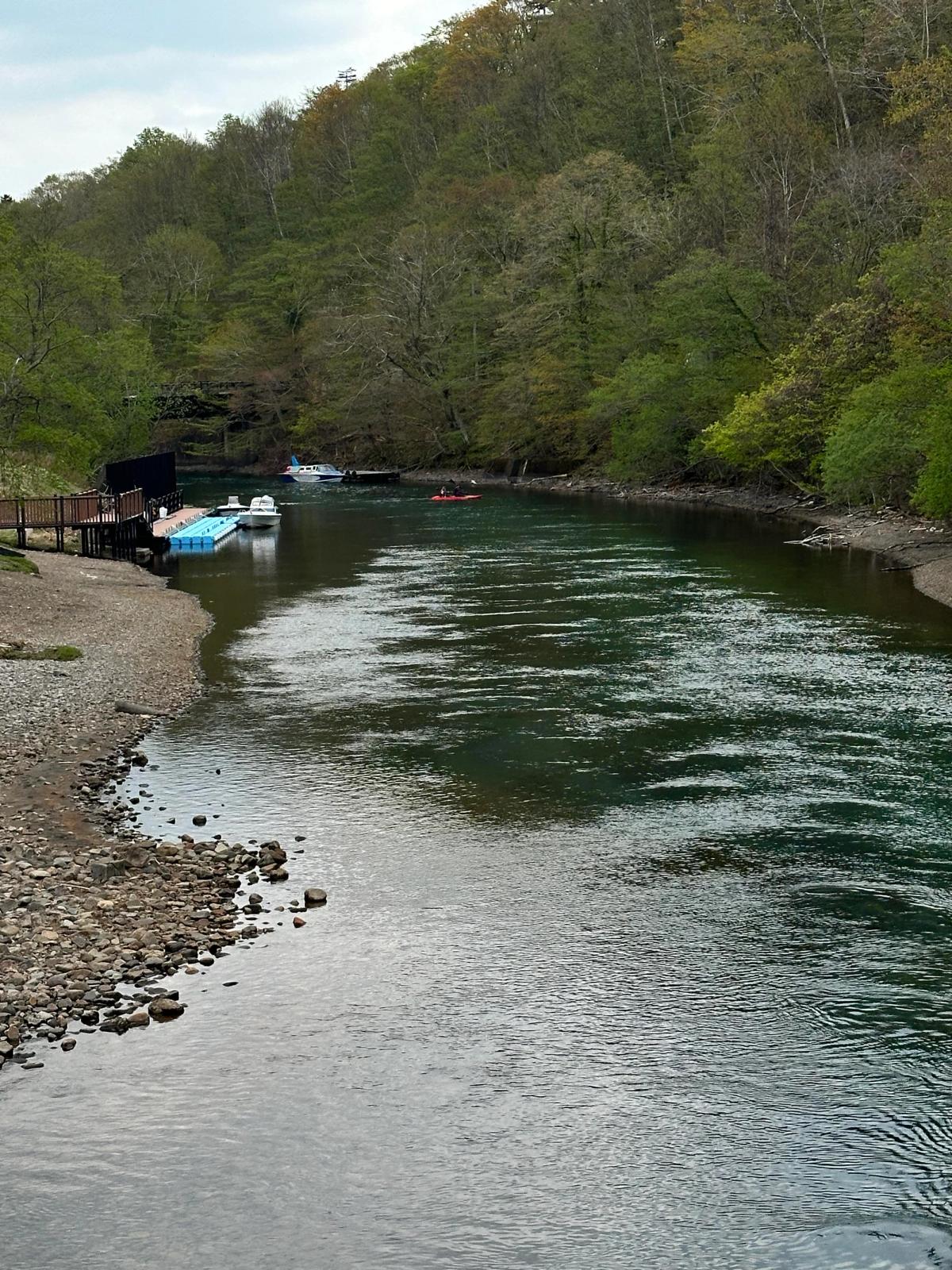
Lake Shikotsu, Hokkaido. caldera lake, water so clear it looks artificial. we passed it on the way to Shiraoi, and i kept turning back to look.
We were heading deeper into Hokkaido, further from the Tokyo version of Japan, and the landscape kept making that clear.
Upopoy National Ainu Museum and Park sits on the shore of Lake Poroto in Shiraoi. I didn't know much about the Ainu before this trip. I knew Japan had an indigenous population the way you know a historical fact without feeling it. Walking into the park changed that.
The Ainu are Hokkaido's first people. Separate language, separate spiritual cosmology, separate relationship to the land that predates anything the Japanese state built here. The Meiji government arrived in the 1870s to develop Hokkaido as a frontier, brought American advisors to help, and in the process spent decades dismantling Ainu culture, banning the language, taking the land, relocating communities. Upopoy opened in 2020 as Japan's national attempt at reconciliation. A museum built to say: we know what happened here.
Before the performance there was archery. Aksinot, Ainu-style. The instructor handed me a bow with no sight, no grip assist, no mechanical help of any kind. Just a curved piece of wood and a string and three arrows. I shot all three. I missed all three. Not close misses either. The bow felt completely foreign in my hands, nothing like anything i'd seen before, no trigger, no leverage point, nothing to cheat with. Just you and the string and whatever judgment you bring. I stood there after the last arrow missed and thought: this is a skill someone spent years building. I had three tries and a tutorial. That gap felt important.
Then we went inside for the Upopo Newa Rimse, the scheduled performance at the Cultural Exchange Hall. I was front row.
The performers moved through several pieces. Songs passed down through Ainu regions. A mukkuri mouth harp whose sound i can only describe as a plucked string echoing inside a small room, shrill and unforgettable. Dances that mimicked birds and water and wind. Each one preceded by a brief explanation. Each one carrying the weight of something that almost didn't survive.
Then came the Iyomante Rimse. The bear dance.
The bear is sacred in Ainu cosmology, a kamuy, a spirit-deity, sent back to the divine world through ceremony. The dance mimics the bear's movements, its life, its departure. Behind the performers on the stage, old black and white footage of an actual Iyomante ceremony played on a screen. Real people, real ritual, filmed decades ago. The performers in front of me were recreating what was in that footage. Keeping it alive by doing it again.
At the end the performers gathered in a circle. The singing continued. The circle closed.
I was sitting front row, close enough to see their faces. Nobody was performing for the audience in that moment. They were performing for something else entirely. I don't have a word for what i felt watching it except that it was the first time on the whole trip that i understood the difference between a culture being preserved in a museum and a culture being kept alive by people who refuse to let it go.
Those are not the same thing.
After the show i walked through the National Ainu Museum. Exhibits on the language, the spiritual world, the material culture, the history of what was done to the Ainu people and what is being done now to bring it back. The Ainu language is classified as critically endangered. There are active revitalization programs. The museum is one of them.
I bought a handmade Ainu feather chain from the craft studio before leaving.
It's small. Feathers and beading, made by hand, the kind of thing that takes patience and knowledge of a specific craft tradition to produce correctly. I carried it to the counter without thinking too hard about it. Someone made this. Someone learned how to make this from someone who learned it before them. Buying it felt less like shopping and more like acknowledging that the chain exists because a person decided this tradition was worth continuing.
I'm aware fifteen dollars isn't reconciliation. But it felt like the honest minimum.
On the bus back toward Tomakomai, Yumi mentioned that Komazawa Tomakomai High School had produced Masahiro Tanaka, the pitcher who played for the New York Yankees. A countryside kid from this edge-of-Japan port town who made it to the Bronx. She seemed genuinely delighted by the improbability of it.
I looked back out the window at the snow depth markers as we passed them.
A road that disappears in winter, marked by poles you have to trust. A culture that nearly disappeared too, now marked by a museum you have to choose to visit. Both are still there if you know to look for them.
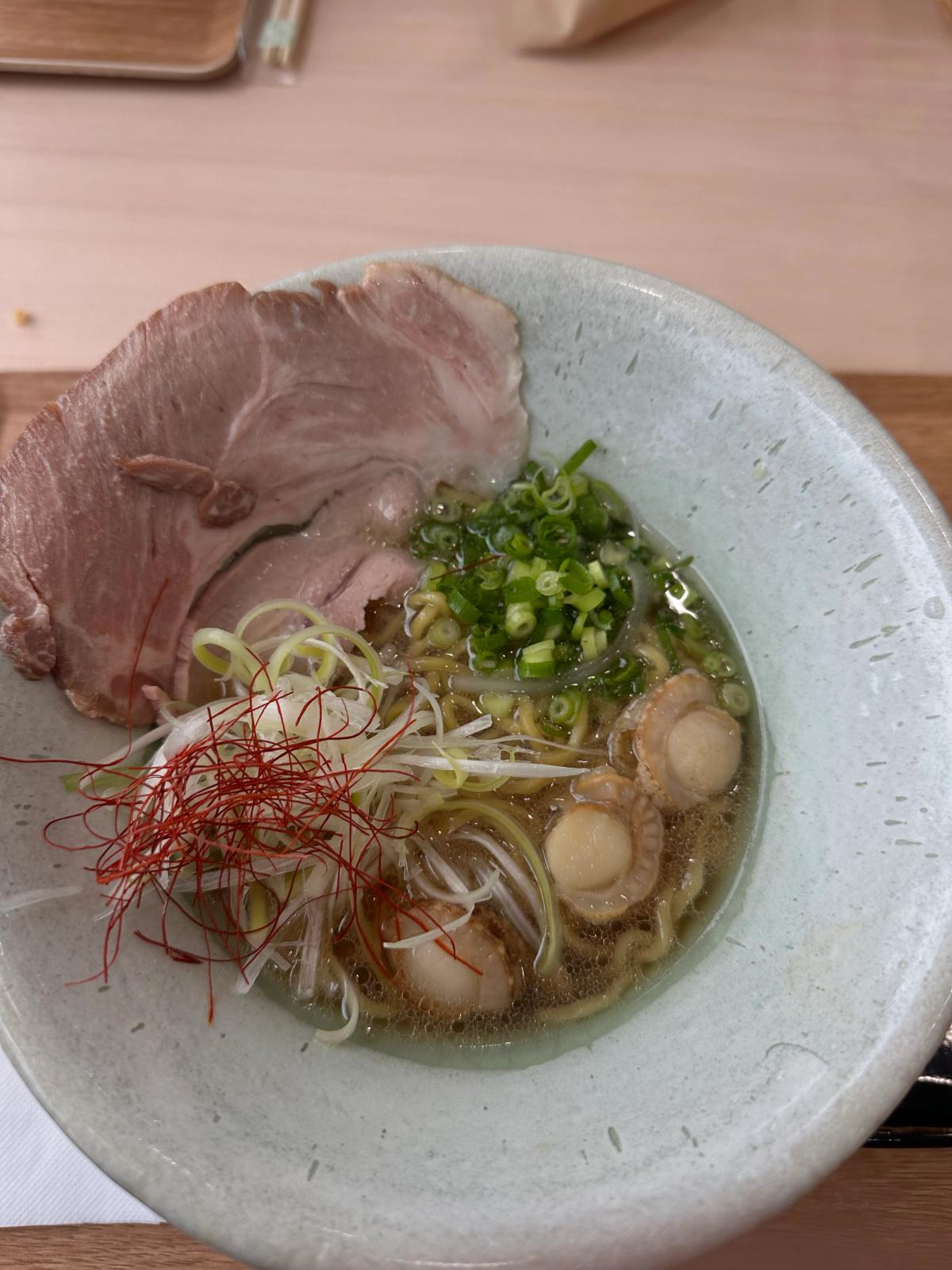
Shio ramen with scallops and chashu, somewhere before Upopoy. Hokkaido does ramen differently than anywhere else in Japan.
A few hours later i was on the Taiheiyo Ferry Kitakami, watching Hokkaido disappear behind us as the ship pushed out into the Pacific.
The ferry had an onsen with a window to the ocean. Hot water, the ship rocking gently underneath everything, the dark water moving outside the glass. I sat in it for a while. Somewhere between Hokkaido and Sendai, somewhere between the bear dance and whatever came next.
I don't know why that felt like the right way to end the day. But it did.